Arizona Elk and Antelope Application Strategies
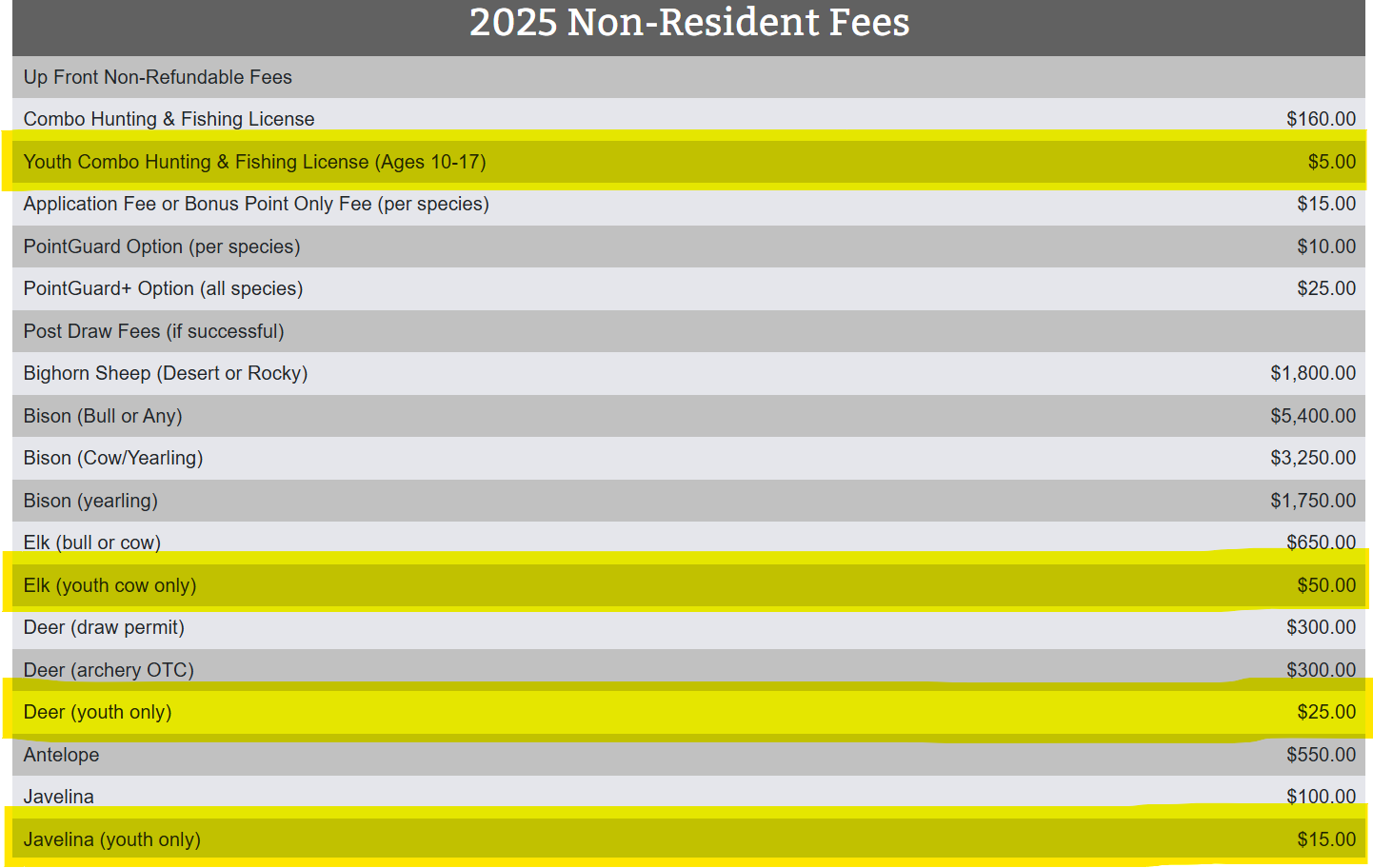
| UP-FRONT FEES | |
| Combo Hunting & Fishing License | $160.00 |
| Youth Combo Hunting & Fishing License (Ages 10-17) | $5.00 |
| Application Fee or Bonus Point Only Fee (Per Species) | $15.00 |
| PointGuard Option (Per Species) | $10.00 |
| PointGuard+ Option (All Species) | $25.00 |
| POST DRAW FEES (IF SUCCESSFUL) | |
| Bighorn Sheep (Desert or Rocky) | $1,800.00 |
| Bison (Bull or Any) | $5,400.00 |
| Bison (Cow/Yearling) | $3,250.00 |
| Bison (Yearling) | $1,750.00 |
| Elk (Bull or Cow) | $650.00 |
| Elk (Youth Cow Only) | $50.00 |
| Deer (Draw Permit) | $300.00 |
| Deer (Archery OTC) | $300.00 |
| Deer (Youth Only) | $25.00 |
| Antelope | $550.00 |
| Javelina | $100.00 |
| Javelina (Youth Only) | $15.00 |
| Turkey | $90.00 |
| Turkey (Youth Only) | $10.00 |
| UP-FRONT FEES | |
|---|---|
| Combo Hunting & Fishing License | $57.00 |
| Youth Combo Hunting & Fishing License (Ages 10-17) | $5.00 |
| Application Fee or Bonus Point Only Fee (Per Species) | $13.00 |
| PointGuard Option (Per Species) | $10.00 |
| PointGuard+ Option (All Species) | $25.00 |
| POST DRAW FEES (IF SUCCESSFUL) | |
| Bighorn Sheep (Desert or Rocky) | $300.00 |
| Bison (Bull or Any) | $1,100.00 |
| Bison (Cow/Yearling) | $650.00 |
| Bison (Yearling) | $350.00 |
| Elk (Bull or Cow) | $135.00 |
| Elk (Youth Cow Only) | $50.00 |
| Deer (Draw Permit) | $45.00 |
| Deer (Archery OTC) | $45.00 |
| Deer (Youth Only) | $25.00 |
| Antelope | $90.00 |
| Javelina | $25.00 |
| Javelina (Youth Only) | $15.00 |
| Turkey | $25.00 |
| Turkey (Youth Only) | $10.00 |
| ARIZONA DEER SEASON DATES | |
| Archery Deer Summer OTC / Draw | Aug 22 – Sep 11, 2025 |
| Mule Deer Early Rifle | Oct 24 – Nov 2, 2025 |
| Coues Deer 1st Rifle | Oct 24 – 30, 2025 |
| Coues Deer 2nd Rifle | Nov 7 – 13, 2025 |
| Mule Deer Late Rifle | Nov 21 – 30, 2025 |
| Coues Deer 3rd Rifle | Nov 28 – Dec 7, 2025 |
| Coues Deer 4th Rifle | Dec 17 – 31, 2025 |
| Archery Deer December OTC | Dec 17 – 31, 2025 |
| Archery Deer January OTC | Jan 1 – 31, 2026 |
| ARIZONA ELK SEASON DATES | |
| Bull Elk Early Archery | Sep 12 – 25, 2025 |
| Bull Elk Early Muzzleloader/Rifle | Sep 26 – Oct 2, 2025 |
| Bull Elk Late Archery | Nov 14 – 27, 2025 |
| Bull Elk Late Muzzleloader/Rifle | Nov 28 – Dec 4, 2025 |
| ARIZONA ANTELOPE SEASON DATES | |
| Rifle | Aug 15 – Aug 31, 2025 |
| Archery | Aug 22 – Sept 4, 2025 |
| Muzzleloader | Sep 5 – Sep 11 or Sep 5 - 14, 2025 |
| ARIZONA SHEEP SEASON DATES | |
| Desert Bighorn | Nov – Dec 31, 2025 |
| Rocky Mountain Bighorn | Oct – Dec 31, 2025 |
| ARIZONA TURKEY SEASON DATES | |
| Fall Turkey (General) | Oct 3 – Oct 9, 2025 |
| Spring Turkey | Apr 25 – May 21, 2025 |
| ARIZONA BISON SEASON DATES | |
| Any Weapon Fall | Aug - Dec, 2025 (Varies by unit) |
| Any Weapon Spring | Jan - Jun, 2026 (Varies by unit) |
| ARIZONA JAVELINA SEASON DATES | |
| Archery | Jan 1 – Jan 22, 2025 |
| Handgun/Archery/Muzzleloader | Feb 6 – Feb 16, 2025 |
| Rifle | Feb 20 – Feb 26, 2025 |
| ARIZONA MOUNTAIN LION SEASON DATES | |
| Statewide (General) | Aug 23, 2025 – May 31, 2026 |
| ARIZONA BEAR SEASON DATES | |
| Spring Bear | Mar 20 – April 23, 2025 (until quota is met) |
| Fall Bear | Aug 21 – Dec 31, 2025 (until quota is met) |
Disclaimer: Arizona big game season dates vary by unit, weapon type, and permit draw. All dates are subject to change by emergency order or regulation updates. Always verify the latest hunt dates and restrictions with the Arizona Game and Fish Department before planning your hunt: https://www.azgfd.com/Hunting/Regulations/
| YEAR | ELK & ANTELOPE | FALL SHEEP, BISON & DEER | SPRING BISON, JAVELINA & TURKEY |
|---|---|---|---|
| 2025 | February 24, 11:20 a.m. (MST) | June 23, 12:10 p.m. (MST) | TBD |
| 2024 | February 26, 10:40 a.m. (MST) | June 24, 11:58 a.m. (MST) | October 18, 10:01 a.m. (MST) |
| 2023 | March 15, 10:20 a.m. (MST) | June 27, 9:57 a.m. (MST) | October 20, 10:00 a.m. (MST) |
| 2022 | March 8, 10:30 a.m. (MST) | July 5, 12:04 p.m. (MST) | October 31, 9:00 a.m. (MST) |
| 2021 | March 20 (system delays) | July 9, 10:46 a.m. (MST) | November 1, 2:00 p.m. (MST) |
| 2020 | March 5, 1:30 p.m. (MST) | July 2, 10:45 a.m. (MST) | November 5, 10:45 a.m. (MST) |
| 2019 | March 8 | July 5 | |
| 2018 | March 8 | July 6 |
Create a FREE ACCOUNT to Unlock
The Arizona 2026 hunting regulations and applications regarding elk and antelope are available to view and print online at www.azgfd.gov. The printed regulations should be available by mail the first week of January. Arizona big game applications for elk and antelope must be submitted by Tuesday, February 3, 2026. Successful applicants should have their permits mailed out by April 1st. Sheep and deer information will not be available until May and will be covered in our June issue. Bison applications and information will be covered in our June and September issues.
To apply, go to www.azgfd.com/hunting/draw and use your customer ID to apply. You should also create a Portal account as you will need it to access your draw results and point totals. Do not delay creating this Portal login. The wait times to get through to tech support may be more than an hour during normal conditions.
Applicants are charged the non-refundable application fee of $15 and the license fee if they haven’t purchased one prior to applying. PointGuard and PointGuard Plus may be purchased at the time of application. Once the draw takes place and if you are successful drawn, the Department will charge the credit card you have on file for the entire permit fee. If payment fails, the Department will not make any attempts to notify that your payment has been declined. Applicants can update their credit card information until the application period has closed.


By Huntin' Fool
By Huntin' Fool
THE ADVISOR SERIES
Create a FREE ACCOUNT to Unlock
Non-residents are limited to up to (not guaranteed) 10% of the elk and antelope tags for a given hunt code. Non-residents may only apply for hunts where none are available for any given hunt code. Non-residents are only eligible for 5% of the 20% quota in the max point draw. The other 5% of the 10% non-resident quota will be available in the random draw. Your first two application choices are considered bonus point choices in the draw. Your third, fourth, and fifth choices will be considered in the “leftover” tags. This will not happen for any bull elk or antelope hunts, as all tags will be taken before they fall to 3rd–5th choice. Bonus points will be purged if any of the five choices are drawn. Groups of up to four hunters may apply together for elk or antelope. Arizona will not over allocate tags to accommodate party applications. Bonus points will be averaged and rounded to the nearest whole number (rounded up if greater than or equal to 0.5). Group applications will be awarded tags if they draw and there are a sufficient number of tags for everyone in the party. There are no waiting periods after being drawn for elk or antelope permits. You must check Arizona’s Portal for draw results.
Hunters may choose the E-tag option when purchasing or applying for any big game hunt. You will not receive a carcass tag if you choose this option. Hunters who choose the E-tag will be required to download the E-tagging app on their phone, upload their big game license, and carry their phone in the field. A printed license and/or carcass tag is not required but flagging or some type of tag will need to be affixed to the antlers for transporting.
Non-residents are limited to up to 10%, not guaranteed, of the deer tags for a given hunt code. Non-residents are limited to up to 5% of this 10% non-resident tag quota in the Bonus Pass draw. The remaining non-resident tag quota of up to 10% may be allocated in the second pass (random pass). Non-residents are issued up to 10% of the total number of sheep and bison tags with no more than 50% per hunt. Up to one non-resident tag can be drawn for sheep when a hunt code offers between two and three tags. If a hunt code offers four or more tags, a maximum of two tags may be issued to non-residents. Non-residents may only apply for hunts that have more than one tag available for any given hunt code. Many sheep units are not eligible to be drawn by non-residents, even though the system will allow the application.
Your first two application choices are considered before the next application is drawn. Your third, fourth, and fifth choices will only be considered if there are leftover tags after the random pass. This will not happen for the trophy units. Bonus points will be purged if any of the five choices are drawn. Groups of up to four hunters may apply together for deer. Residents and non-residents may apply together in a group. Bonus points will be averaged and rounded to the nearest whole number (rounded up if greater than or equal to 0.5). Group applications will be awarded tags if they draw and there are a sufficient number of tags for everyone in the party.
You may only harvest one Desert bighorn sheep, one Rocky Mountain bighorn sheep, and one bison in your lifetime in Arizona. There are no waiting periods for deer. Check Arizona’s website Portal system for draw results.
Create a FREE ACCOUNT to Unlock
$199 BILLED ANNUALLY
Everything in Pro, plus unlimited one-on-one hunt consultations, and everything you need to prep like a pro and hunt like a fool.
$48 BILLED ANNUALLY
Access community intel, research tools, and our online magazine. Draw more tags and go on more hunts with better information.
Our members experience improved hunting opportunities as a direct result of the Huntin' Fool magazine. We are the only publication that breaks more than 20 states' hunting regulations and draw systems into bite-sized chunks for our members.
Online applications can be paid for with Visa, MasterCard, or Discover only. There is a $15 non-refundable application fee that is collected for each species when applying in Arizona. The non-refundable fee of $15 is also charged when only applying for a bonus point. A $160 combination hunting license is required for non-residents to apply for big game hunts, and it is valid for one year from the date of purchase. Enrollment in PointGuard costs an additional $5 per species, and PointGuard Plus is valid for all species for 365 days from the time of enrollment for $25.
No one under the age of 14 may hunt big game in Arizona without having completed a hunter education course. Arizona does not require hunter orange clothing to be worn while hunting big game.
Advisor Articles from Our Magazine on Arizona Application and Hunting Strategy
No one under the age of 10 may hunt big game in Arizona. Youth are eligible to apply for a tag if they have completed a hunter education course and are at least 10 years old at the start of the hunt. They may apply for bonus points if they are 10 years old by the application deadline.
Arizona has a bonus point system where applicants who apply and are unsuccessful in drawing a tag will obtain another bonus point for the following year’s draw. Applicants who have submitted a valid application for a species every year for five consecutive years will automatically be awarded another point (a loyalty point) in addition to the points they have already accumulated. Points are species specific and cannot be transferred to another species or applicant. For every applicant who applies will have an additional chance in the drawing for that species. If a hunter fails to apply five consecutive years for a particular species, bonus points for that species will be purged.
Arizona has always offered an extra lifetime bonus point that is applied to all species applications for hunters who have passed an AZGFD hunter education course. However, in 2021, AZGFD changed the requirement for obtaining this lifetime bonus point to simply taking an online course and paying a fee. Non-residents pay $300, and residents pay $50. You must be 18 years or older to take the class. A student will have two opportunities to pass the course with a minimum score of 80%. The course must be passed 30 days prior to the draw deadline day for bonus point to be valid for that particular draw. For more information on how to sign up to take the course, go to www.hunter-ed.com/ethically-hunting-arizona/.
If a hunter already has earned an Arizona Education Bonus point by completing Arizona Hunter Education, a second bonus point cannot be obtained through the taking of the Ethically Hunting Arizona course. In addition, completing the online course does not fulfill hunter education requirements to hunt in other states.
Applicants may apply for points only and will be guaranteed not to draw but will obtain a bonus point. Applicants who want to apply for points only are required to buy a $160 license and pay the $15 application fee per species.
Applicants who have submitted a valid application for a species every year for five consecutive years will automatically be awarded another point (a loyalty point) in addition to the points they have already accumulated. Points are species specific and cannot be transferred to another species or applicant. For every point accumulated, applicants will have an additional chance in the drawing for that species. If a hunter fails to apply for five consecutive years for a particular species, bonus points for that species will be purged. If a hunter draws any of the five choices on the application, bonus points will be purged for that species. Points are not affected if you obtain a leftover deer tag in the first-come, first-served process.
In addition, 20% of the deer tags for each hunt and 20% of the total number of sheep and bison tags are reserved for applicants with the most bonus points. Non-residents are limited to up to 5% in the bonus pass and the remaining percentage in the random pass. For 2025, the maximum number of bonus points hunters can have going into the draw for elk and antelope is 35, sheep is 36, for bison is 60, and for deer is 28, including the hunter education point and loyalty point.
Applicants may apply for points only and will be guaranteed not to draw a hunt but will obtain a bonus point. Applicants who want to apply for points only are required to buy a $160 license and pay the $15 application fee per species.
Create a FREE ACCOUNT to Unlock
By Huntin' Fool
By Huntin' Fool
By Huntin' Fool
By Huntin' Fool
By Huntin' Fool
By Huntin' Fool
THE ADVISOR SERIES
The fifth column in the hunt tables represents the minimum number of points needed to be considered in the bonus pass. Not all applicants with the amount of points listed draw a tag, but they were eligible in the bonus pass. We have listed the minimum number of points needed for residents as well as non-residents for the elk draw. The “Simple Draw Odds” listed in the tables are not the true draw odds. The odds we list are the number of first and second choice applicants minus the second choice applicants who drew their The fifth column in the hunt tables represents the minimum number of points needed to be considered in the bonus pass. Not all applicants with the amount of points listed draw a tag, but they were eligible in the bonus pass. We have listed the minimum number of points needed for residents as well as non-residents for the elk draw. The “Simple Draw Odds” listed in the tables are not the true draw odds. The odds we list are the number of first and second choice applicants minus the second choice applicants who drew their
Arizona has created a youth hunt program. The hunting/fishing license cost for youth hunters under 18 years of age is $5. Only youth between the ages of 10 and 17 may apply for Arizona’s juniors-only hunts. The juniors-only elk tags will be for antlerless elk only and cost $50. All bull elk hunts will be at the regular non-resident fee. There are no juniors-only antelope permits for 2026. Arizona will allow a parent, grandparent, or guardian to whom a big game hunt tag is issued to transfer the tag to a minor child who is 10-17 years old on the date of the transfer. The minor child must have a valid youth combination hunting and fishing license on the date of the transfer, and, if they are younger than 14 years old, they must have completed a Department-approved hunter education course by the beginning of the hunt.
Create a FREE ACCOUNT to Unlock
Arizona places very few restrictions on muzzleloaders. Scopes of any magnification are legal as well as muzzleloading rifles with any type of ignition firing any type of projectile. Crossbows are not legal during the archery seasons in Arizona without a special permit. Bows must have a standard pull of 30 pounds or more using arrows with broadheads no less than 7/8 inches in width with metal cutting edges.
Following the main drawing, any remaining permits available for elk and antelope will be available to residents and non-residents on a first-come, first-served basis. These permits are referred to as first-come permits. Applications will be accepted by mail on or after 8 a.m. MST on March 16, 2026. A list of leftover permits is available online at www.azgfd.gov/Hunting under “Big Game Draw” or at any Department office. Arizona does not have a landowner tag system. They offer raffle tags for each of the big game species within the state. The lucky winner of each of the big game Super Raffle tags will be permitted to hunt for up to 365 days beginning August 15, 2026. All public land within all game management units will be open to hunt. All residents and non-residents can participate. All raffle tickets must be purchased within the state of Arizona to be valid.
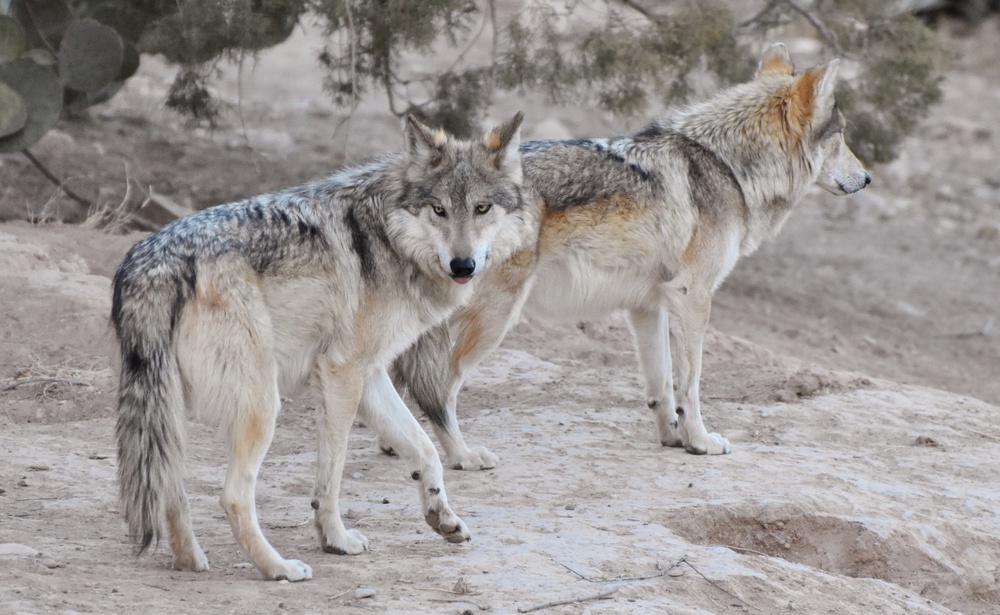
Arizona has a growing population of Mexican gray wolves in the eastern portion of the state. The Mexican gray wolf population is starting to increase more rapidly, and they are having negative impacts on elk populations in isolated areas along the New Mexico border. Through the third quarterly wolf update of 2025, 149 livestock have been killed by wolves across Arizona and New Mexico. Additional information can be found at www.azgfd.com as well as subscribing to AZGFD’s Mexican Wolf Update email.
Applicants will have their permits mailed out by April 1, 2026. You can update your credit card information until the update card period has ended. Keep an eye on the AZGFD website for the deadline to update your card information. You cannot modify your application once it is submitted.
Arizona allows applicants with a valid AZGFD Portal account who purchased either PointGuard or PointGuard Plus to surrender their tag one time only for bonus point purposes for any reason the business day prior to the opening day of the hunt. Applicants are required to surrender the permit along with a completed Tag Surrender Application Form to AZGFD. All bonus points will be reinstated plus applicants gain a point for that year’s application. Applicants will forfeit tag fees associated with the tag. If the applicant chooses to surrender their tag, they will not be eligible for the PointGuard program again for that species until their bonus points for that species have been purged. Applicants can choose to be enrolled in the PointGuard program for each individual species during the online application process for a $10 non-refundable fee per species. Applicants can also choose to be enrolled in the PointGuard Plus program, which enrolls them for all species for a 365-day term for a $25 non-refundable fee.
Arizona will allow a parent, grandparent, or guardian to whom a big game hunt tag is issued to transfer the tag to a minor child who is 10-17 years old on the date of the transfer. The minor child must have a valid youth combination hunting and fishing license on the date of the transfer, and, if they are younger than 14 years old, they must have completed a Department-approved hunter education course by the beginning of the hunt. Arizona will also allow a person to transfer tag to a non-profit organization that provides opportunities and experiences to children with life-threatening medical conditions.
Elk and antelope harvest reporting in Arizona is voluntary. We strongly encourage all hunters to complete their hunt survey to help with accurate harvest data
Arizona works with different ranches throughout the state to secure private land for public use. Most of these ranches allow access through a sign-in box at the gate, but more information on which units and ranches have private land that is accessible by the public can be found at www.azgfd.gov/Hunting.
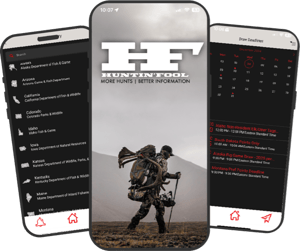
Huntin’ Fool offers a wide variety of services and resources within the hunting space, and the Huntin’ Fool App offers access to them all. Utilizing this app, you will be able to apply for hunts, plan hunts, buy hunts, and win hunts. This app is simple to use and puts the tools you need to go on great hunts right at your fingertips.
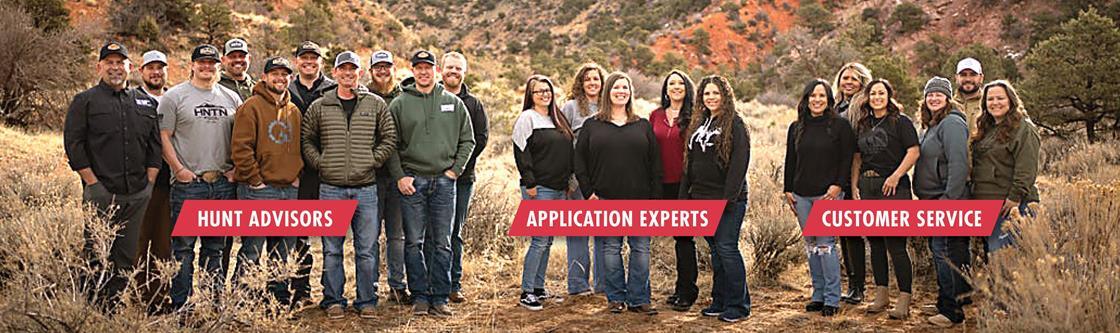
At Huntin' Fool, we are always looking for ways to improve our service and help out members to the very best of our abilities. We believe communication is what makes our Huntin' Fool community great!
In Arizona, the cost of a hunting license depends on residency status and license type. Residents can purchase a General Hunting License for $37, or a Combination Hunt and Fish License for $57. Non-residents must buy a Combination Hunt and Fish License for $160, as the general hunting license is not available to them. A Youth Combination Hunt and Fish License is available to both residents and non-residents for $5 (ages 10–17). Short-term Combination Licenses are also offered at $15 per day for residents and $20 per day for non-residents, though these are not valid for big game or the draw. Licenses are valid for 365 days from the date of purchase, and big game hunting requires additional permit-tags or nonpermit-tags beyond the base license.
An out-of-state (non-resident) hunting license in Arizona costs $160 for a Combination Hunt and Fish License. There is no standalone General Hunting License available for non-residents, and youth ages 10–17 can purchase a Youth Combination Hunt and Fish License for $5. A Short-term Combination Hunt and Fish License is also available for $5 but cannot be used for big game hunting or applying for the draw.
Non-resident hunting licenses are more expensive because state wildlife agencies primarily fund conservation and wildlife management through license sales, and residents already contribute through state taxes. Charging non-residents higher fees helps ensure they contribute fairly to the resources they use without placing an extra burden on residents. Higher non-resident fees also help manage hunting pressure by limiting the number of out-of-state hunters and maintaining quality hunting experiences for both residents and visitors.
In Arizona, hunters can pursue a variety of big game species, including deer, pronghorn, elk, javelina, bear, mountain lion, bighorn sheep, bison, and turkey.
Yes, Arizona offers some of the best hunting opportunities in the country. The state is known for its diverse terrain and healthy wildlife populations, providing excellent chances to hunt prized big game species like elk, mule deer, Coues deer, pronghorn, bighorn sheep, and bison. Arizona is especially famous for producing trophy-quality animals, particularly in elk and deer hunts, and offers a mix of challenging public land hunts and highly sought-after limited-entry tags through its draw system.
Yes, you can hunt on Arizona state trust land if you are properly licensed and lawfully taking wildlife. Licensed hunters are considered permittees and are allowed access even if the land is posted with "State Land — No Trespassing" signs. However, hunters must have a valid Arizona hunting license, must not trespass on private land to reach state trust land, and must conduct activities within the lawful scope of hunting or fishing. State trust land near occupied buildings or livestock facilities (within one-quarter mile) may be closed to hunting without further notice, and hunters must obey all posted signage. It is also unlawful to block, fence, or deny legal access to existing roads on state land. In short, while state trust land is generally open to hunting, hunters must follow specific access rules and respect closures and regulations.
Yes, you can generally hunt on Bureau of Land Management (BLM) land in Arizona. Most BLM lands are open to hunting unless specifically closed, and several BLM-managed National Monuments, like Grand Canyon-Parashant, Vermilion Cliffs, Sonoran Desert, Ironwood Forest, and Agua Fria, also allow hunting. Arizona’s Game Management Units (GMUs) often include BLM land, so hunters should identify the GMU they plan to hunt and check for any specific rules. It’s important to verify current conditions or closures by contacting the appropriate BLM field office. In jointly managed areas like Grand Canyon-Parashant, hunting is allowed on both BLM and National Park Service lands, but motorized vehicle restrictions and other regulations may differ between the two. In wilderness areas on BLM land, motorized travel is generally prohibited, so hunters must be prepared for remote conditions. Accessing BLM land must be done legally without trespassing on private land, and hunters should review hunt unit maps and boundaries in the Arizona hunting regulations. Always check specific area rules before hunting to ensure compliance.
Arizona’s hunting seasons vary widely depending on the species and weapon type, and hunters must consult the Arizona Game and Fish Department’s Commission Orders each year for the most accurate information. Big game species like deer, elk, pronghorn, javelina, bighorn sheep, bison, bear, and mountain lion each have specific seasons that may require a draw permit-tag or allow hunting with a nonpermit-tag. Small game and upland birds like quail, squirrel, rabbit, and dusky grouse also have set seasons, as do migratory birds and predators like coyotes and bobcats. Season dates differ by Game Management Unit (GMU), weapon choice (general, muzzleloader, archery), and sometimes even by sub-species (like Mearns’ quail). Some species, like deer and javelina, offer both draw and non-draw (over-the-counter) hunting opportunities. It’s important to note that different lands (such as BLM, state trust land, and national monuments) may have additional access rules. Application deadlines for draw permits are typically early in the year, and hunters must also follow reporting requirements for species like bear, mountain lion, bison, and archery deer. Legal hunting hours are from one-half hour before sunrise to one-half hour after sunset, and hunting in city parks, airports, and other restricted areas is prohibited unless specifically opened. Always refer to the latest hunting regulations at www.azgfd.gov to plan your hunt accurately.