Montana General Elk and Deer
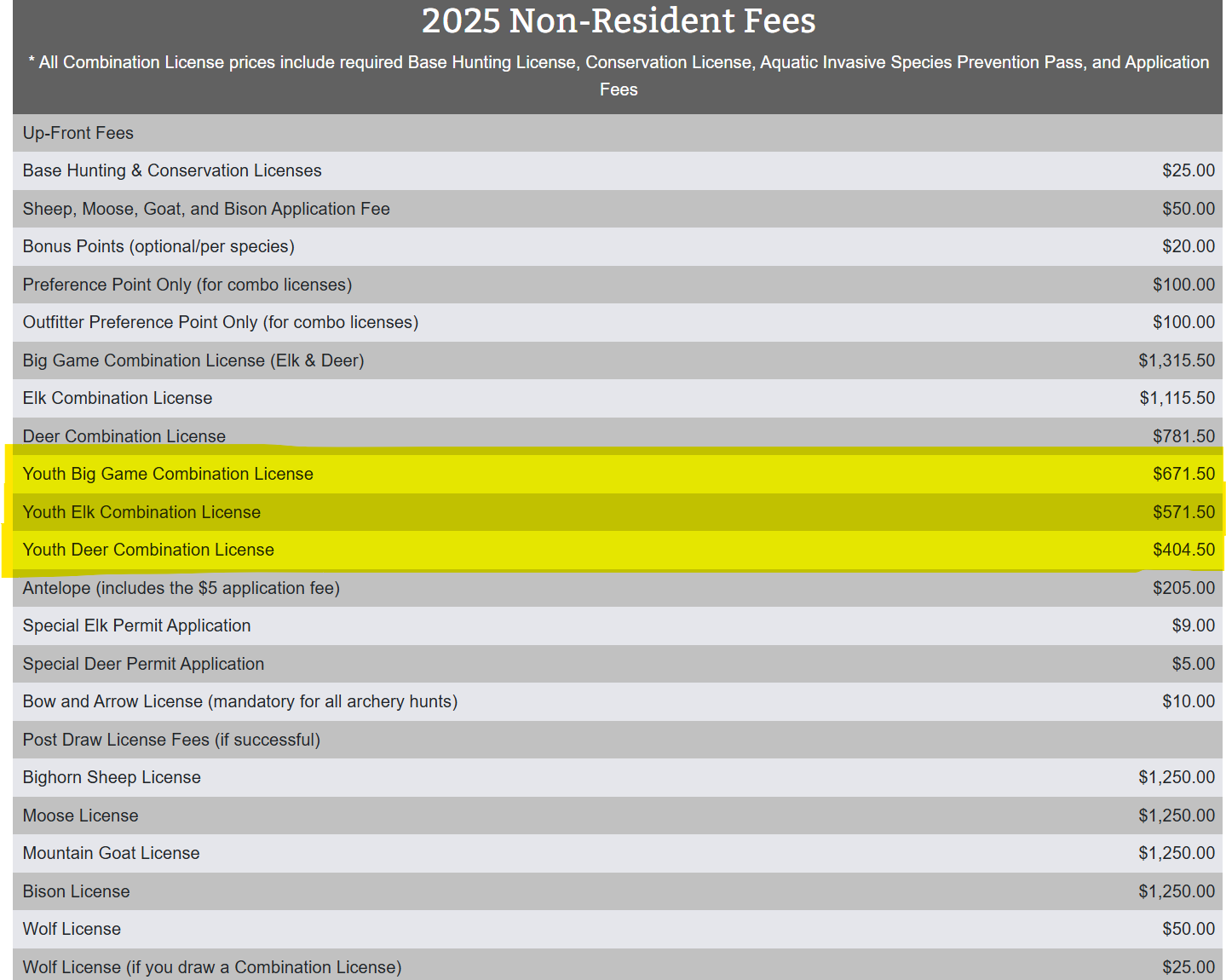
| UP-FRONT FEES | |
| Base Hunting & Conservation Licenses | $25.00 |
| Sheep, Moose, Goat, and Bison Application Fee | $50.00 |
| Bonus Points (Optional/Per Species) | $20.00 |
| Preference Point Only (For Combo Licenses) | $100.00 |
| Outfitter Preference Point Only (For Combo Licenses) | $100.00 |
| Big Game Combination License (Elk & Deer)* | $1,315.50 |
| Elk Combination License* | $1,115.50 |
| Deer Combination License* | $781.50 |
| Youth Big Game Combination License* | $671.50 |
| Youth Elk Combination License* | $571.50 |
| Youth Deer Combination License* | $404.50 |
| Antelope (Includes the $5 Application Fee) | $205.00 |
| Special Elk Permit Application | $9.00 |
| Special Deer Permit Application | $5.00 |
| Bow and Arrow License (Mandatory for All Archery Hunts) | $10.00 |
| *All Combination License prices include required Base Hunting License, Conservation License, Aquatic Invasive Species Prevention Pass, and Application Fees | |
| POST DRAW FEES (IF SUCCESSFUL) | |
| Bighorn Sheep License | $1,250.00 |
| Moose License | $1,250.00 |
| Mountain Goat License | $1,250.00 |
| Bison License | $1,250.00 |
| Wolf License | $50.00 |
| Wolf License (If You Draw a Combination License) | $25.00 |
| UP-FRONT FEES | |
| Base Hunting & Conservation Licenses | $18.00 |
| Sheep, Moose, Goat, and Bison Application Fee | $10.00 |
| Bonus Points (Sheep, Moose, Mountain Goat) | $75.00 |
| Bonus Points (Elk, Deer, Antelope) | $25.00 |
| General Deer License | $16.00 |
| Deer B License | $10.00 |
| Youth General Deer License | $8.00 |
| General Elk License | $20.00 |
| Elk B License | $20.00 |
| Youth General Elk License | $10.00 |
| Antelope (Includes the $5 Application Fee) | $19.00 |
| Bow and Arrow License (Mandatory for All Archery Hunts) | $10.00 |
| POST DRAW FEES (IF SUCCESSFUL) | |
| Bighorn Sheep License | $125.00 |
| Moose License | $125.00 |
| Mountain Goat License | $125.00 |
| Bison License | $125.00 |
| Wolf License | $10.00 |
| MONTANA ELK SEASON DATES | |
| Archery | Sep 6 – Oct 19, 2025 |
| Rifle | Oct 25 – Nov 30, 2025 |
| Backcountry (HDs 150, 280, 316) | Sep 15 – Nov 30, 2025 |
| MONTANA DEER SEASON DATES | |
| Archery | Sep 6 – Oct 19, 2025 |
| Rifle | Oct 25 – Nov 30, 2025 |
| Backcountry (HDs 150, 280, 316) | Sep 15 – Nov 30, 2025 (Archery Sep 6 – Sep 14) |
| Youth Hunt | Oct 16 – 17, 2025 |
| MONTANA ANTELOPE SEASON DATES | |
| Archery | Sep 6 – Oct 10, 2025 |
| Archery (900) | Aug 15 - Nov 9, 2025 |
| Rifle | Oct 11 – Nov 9, 2025 |
| MONTANA BISON SEASON DATES | |
| Any Weapon | Sep, 2025 - Feb 2026 (varies by unit) |
| MONTANA MOOSE SEASON DATES | |
| Controlled Hunts | District-specific; generally Sep 15 – Nov 29 |
| MONTANA BIGHORN SHEEP SEASON DATES | |
| Archery | Sep 6 - Sep 14 (varies by unit) |
| Any Weapon | Sep 15 - Nov 30 (varies by unit) |
| MONTANA MOUNTAIN GOAT SEASON DATES | |
| Archery | Sep 6 - Sep 14 (varies by unit) |
| Any Weapon | Sep 1 - Nov 30 (varies by unit) |
| MONTANA WOLF SEASON DATES | |
| Archery | Sep 6 – Sep 14, 2025 |
| General | Sep 15, 2025 – Mar 15, 2026 |
| Trapping | Date is dependent on location |
| MONTANA BLACK BEAR SEASON DATES | |
| Spring | Apr 15 – June 15, 2025 |
| Fall | Sep 15 – Nov 30, 2025 |
Disclaimer: Dates vary by hunting district (HD) and may change through emergency regulations. Always confirm with Montana FWP before planning your hunt: : https://fwp.mt.gov/hunt
| YEAR | ELK & DEER | MOOSE, MTN GOAT, SHEEP & BISON | ANTELOPE 900-20 & B LICENSES | RIFLE ANTELOPE / SUPER TAGS |
|---|---|---|---|---|
| 2025 | April 15, 3:05 p.m. | May 7, 2:20 p.m. | June 13 | |
| 2024 | April 15, 3:38 p.m. | May 8, 3:00 p.m. | June 17 | Early August |
| 2023 | April 17, 3:08 p.m. | May 12, 3:50 p.m. | June 14 | Aug 8 |
| 2022 | April 14, 1:14 p.m. | May 10, 10:00 a.m. | June 13 | |
| 2021 | April 14, 11:00 a.m. | May 11, 9:44 a.m. | June 18 | |
| 2020 | April 14, 4:00 p.m. | May 11, 9:45 a.m. | June 15 | August 6 |
| ANNUAL | Mid-July (Super Tags) |
Create a FREE ACCOUNT to Unlock
In this issue, we will only be covering Montana’s deer and elk hunts. As a non-resident, if you draw a general combination license, you can hunt all the general units in the state. Montana residents can purchase general licenses over the counter.
Montana Fish, Wildlife, and Parks (FWP) prints several different sets of regulations covering all the different species, and each has its own release date. Application periods for the different species are staggered. We will cover sheep, moose, mountain goat, bison, and antelope hunts in our April issue.
Non-resident general and limited deer and elk applications must be submitted online by 11:45 p.m. MDT on April 1. Montana’s regulations are available for download online at https://fwp.mt.gov/hunt/regulations, or you can request a physical copy by calling 406-444-2535.
Montana has a complicated application process for non-residents. If you’re a non-resident, you’ll need to apply for one of the big game, elk, or deer combination licenses in the general draw in order to apply for special, limited-entry deer or elk permits. Both applications are due by April 1 at 11:45 p.m. MST. Montana only accepts online applications for its big game draws. You may apply online at https://fwp.mt.gov/buyandapply.
Party applications are available for elk and deer and have a maximum party size of five. Preference points will be averaged to a decimal, while bonus points will be averaged and rounded to the nearest whole number. All big game hunting applications are final after submission. You may not withdraw or amend any of your big game hunting applications.
Applicants wishing to apply for bonus points only for any species may do so from July 1 through September 30. Applicants wishing to apply for a preference point only may do so from July 1 through December 31. When applying for bonus or preference points only, applicants may only apply for one preference or bonus point per species per year.
If you apply for a combo license and limited-entry hunts, the corresponding preference or bonus point may only be purchased at the time of application. You will be locked out of the upcoming points-only period and will be ineligible to purchase a point for anything previously applied for in the general-combination and special drawings that year.


By Huntin' Fool
By Huntin' Fool
By Huntin' Fool
THE ADVISOR SERIES
Create a FREE ACCOUNT to Unlock
Everyone’s first choice is awarded before anyone’s second choice is considered. For deer and elk, draw results will be available mid-April. There is no waiting period for applying again if you have previously drawn an elk or a deer permit.
Elk and deer non-resident applicants are allocated up to ten percent of the permit quota, though that is not guaranteed. If a non-resident applies for a deer or elk permit area that has a quota under ten, their application will not be considered for the drawing.
$199 BILLED ANNUALLY
Everything in Pro, plus unlimited one-on-one hunt consultations, and everything you need to prep like a pro and hunt like a fool.
$48 BILLED ANNUALLY
Access community intel, research tools, and our online magazine. Draw more tags and go on more hunts with better information.
Our members experience improved hunting opportunities as a direct result of the Huntin' Fool magazine. We are the only publication that breaks more than 20 states' hunting regulations and draw systems into bite-sized chunks for our members.
Applicants will need a Visa, MasterCard, Discover, American Express, or debit card to apply. When applying, license fees must be paid for at the time of application.
The Montana bonus and preference point systems are voluntary. Or non-residents, the bonus point costs $20 per species. A preference point for the general combination drawing costs $100 for non-residents. When applying online, you will be charged a convenience fee of $0.20, and an additional three percent of the total purchase will be added to your application fees.
Advisor Articles from Our Magazine on Montana Application and Hunting Strategy
Anyone born after January 1, 1985, must have taken a hunter education course to purchase a hunting license in Montana. In order to purchase an archery license, you must provide either a certificate showing completion of a bowhunter education course or any prior year’s bowhunting permit from any other state. Hunters and those accompanying a hunter as an outfitter or guide must wear a minimum of 400 square inches of visible hunter orange material above the waist. This rule does not apply during the archery-only season.
An eleven-year-old who will be twelve years old by January 16, 2027, may purchase a hunting license and apply for any drawing but cannot hunt until after August 15, 2026.
Bonus points will be issued for the special deer and elk drawings. The maximum number of bonus points someone can have going into the 2026 draw for deer and elk is 24 points. A bonus point purchased at the time of application will be added to your existing point total and used in the draw. Bonus points are squared in the drawing. For example, if you have 3 points, that gives you nine chances. You will also receive an additional chance for the current year, giving you a total of ten chances in the drawing. Accumulated bonus points will only be used if you draw your first choice. Party applications will have their bonus points averaged and rounded to the nearest whole number. Bonus points are not used or lost in second and third choice drawings.
Preference points are issued for the resident general-combination drawings. While seventy-five percent of general combination licenses will be issued to non-resident applicants with the most preference points, the other twenty-five percent will be issued to applicants who were unsuccessful in the preference point draw and have zero points. Montana does this to give hunters with no points a chance at drawing a combination license. Participation in the preference point system is voluntary. Only purchase a preference point for the general license drawing if you intend to apply in the next year’s draw. Otherwise, if you don’t apply the following year, your preference points will be purged.
There is a $100 outfitter preference point available to hunters applying with an outfitter. The hunter can buy both the normal preference point and the outfitter preference point going into the draw, giving them two preference points. However, if you buy an outfitter preference point, you are required to hunt with the outfitter you applied with for the entirety of your hunt.
Create a FREE ACCOUNT to Unlock
By Huntin' Fool
By Huntin' Fool
By Huntin' Fool
By Huntin' Fool
By Huntin' Fool
THE ADVISOR SERIES
Montana gives non-residents up to ten percent of the big game tag quota. We’ve listed the prior year’s first choice draw odds based on if that applicant had 1, 5, 10, or 15 points going into the draw. This will give applicants at various point levels a better idea of their draw odds for a given hunt, and it also gives applicants a timeframe for when they can anticipate having better draw odds.
For detailed draw odds where you can enter in your points to see exactly what your odds were last year, go to research.huntinfool.com.
Under the Apprentice Hunter program, youth ages ten through seventeen can get out in the field and hunt prior to having taken a hunter education course. An apprentice hunter must still purchase all applicable licenses, and they must also be accompanied by a mentor twenty-one or older who has completed the Apprentice Hunter Mentor Form available online or at regional Montana FWP offices. Additionally, the apprentice must obtain a $5 Apprentice Hunter Certification from a regional Montana FWP office or online at https://fwp.mt.gov/. Apprentice hunters cannot apply for limited-entry draws, and they can only obtain an Apprentice Hunter Certification for two license years before they will be required to complete a hunter education course. Contact the licensing department directly with any questions.
In many units, youth ages twelve to fifteen may harvest a cow elk with their elk license without having to draw a cow elk permit. Legally licensed youth hunters who are ten to fifteen years of age may also hunt deer during the statewide two-day, youth-only deer season, which runs October 15 through 16.
Create a FREE ACCOUNT to Unlock
For archery, your bow must be handheld and at least 28” in length to be considered legal. Arrows must be at least 20” in length and have a total weight greater than 300 grains. Broadheads must weigh 70 grains or more and have two cutting edges. Expandable broadheads are also legal so long as they expand to at least 7/8”.
The following muzzleloader restrictions apply only to weapon restriction areas: they must not be capable of being loaded from the breech of the barrel; may not be loaded with any pre-prepared paper or metallic cartridges; must be charged with black powder, pyrodex, or an equivalent; must be ignited by a percussion, flintlock, matchlock, or wheelock mechanism; must be a minimum of .45 caliber; may have no more than two barrels; and must only use plain lead projectiles. Sabots, or other similar power- and range-enhancing manufactured loads that enclose the projectile from the rifling or bore of the firearm, are prohibited.
One Super Tag will be drawn for each species and can be used in any hunting district. Revenue from Super Tag sales is used to enhance hunting access and boost Montana FWP enforcement efforts. Unlimited Super Tag chances may be purchased for $5 each at https://fwp.mt.gov/buyandapply, though you must have a current conservation license to do so. Super Tag chances are available for bighorn sheep, moose, mountain goat, bison, elk, deer, antelope, and mountain lion. The number of Super Tag chances purchased in 2025 for each species are as follows: 53,568 bighorn sheep, 31,221 moose, 15,348 mountain goat, 13,726 bison, 41,214 elk, 17,705 deer, 11,195 antelope, and 3,685 mountain lion.
As of February 16, 2026, a total of 227 wolves have been harvested during the 2025/2026 Montana wolf harvest season. On average, around 300 wolves are harvested each hunting season, with 297 taken in the 2024/2025 season. Roughly two-thirds of harvested wolves are taken by hunters, while the rest are typically taken by trappers. The wolf trapping and hunting season will end on March 15, 2026. We encourage hunters to have a wolf tag in their pocket if they are hunting in Western Montana.
Applicants who are successful in drawing a general license will be placed in the special drawing if they applied for it. For big game combination or elk combination licenses, you will be able to choose from the following options if unsuccessful in the special drawing: keep your general license to use during general seasons; receive an eighty percent refund; or, if you drew a big game combination license and were unsuccessful in drawing a special elk permit, you may elect to receive a $420.80 refund for the elk license and be issued a deer combination license to use during general deer seasons.
If you successfully draw a deer combination license but are unsuccessful in the special drawing, you can return your license for an eighty percent refund by August 1 or a fifty percent refund before the start of the general hunting season. All refunds will be mailed to unsuccessful applicants in the form of a check.
All big game hunting applications are final after submittal. You may not withdraw or amend any of your big game hunting applications. License refunds are available in some situations, such as death, death of a family member, or medical emergency. Call 406-444-2950 for more information.
Montana does not have mandatory harvest reporting requirements for deer and elk taken using paper licenses.
Montana allows hunters the option to use electronic tags. The Montana MyFWP app provides a digital wallet to store and display licenses and digital carcass tags, known as E-Tags, that can validate your harvest in the field. When you validate your E-Tag, it automatically reports your harvest to Montana Fish, Wildlife, and Parks.
In 1985, Montana started a Block Management program, which is a cooperative program between private landowners and Montana FWP. Block Management helps landowners manage hunting activities and provides the public with free hunting access to private land and, sometimes, to adjacent or isolated public lands. Currently, hunters can hunt 6.8 million acres of private land for free. Funding for the program comes from the sale of various licenses. A regional Hunting Access Guide is published annually by August 15, listing the Block Management areas enrolled for that year and explaining how to gain access to them. Call 406-444-2612 for more information.
Huntin’ Fool offers a wide variety of services and resources within the hunting space, and the Huntin’ Fool App offers access to them all. Utilizing this app, you will be able to apply for hunts, plan hunts, buy hunts, and win hunts. This app is simple to use and puts the tools you need to go on great hunts right at your fingertips.
At Huntin' Fool, we are always looking for ways to improve our service and help out members to the very best of our abilities. We believe communication is what makes our Huntin' Fool community great!
In Montana, the big game animals you can hunt include deer (both mule deer and white-tailed deer), elk, antelope, moose, bighorn sheep, mountain goat, bison, black bear, and mountain lion. Most of these species require specific licenses or permits, often available through a drawing. SuperTags offer additional chances for species like moose, sheep, goat, bison, antelope, and mountain lion. While wolves are also huntable, they are managed separately and not typically categorized under big game. Grizzly bears, however, are not legal to hunt in Montana.
A nonresident hunting license in Montana costs $15.00 for the Base Hunting License and $10.00 for the Conservation License, which are required before purchasing most other licenses. From there, the cost depends on what species and license type you're applying for. Here are some common nonresident big game license costs:
Big Game Combination License (Deer + Elk + Upland Bird + Fishing): $1,278.00
Elk Combination License: $1,078.00
Deer Combination License: $744.00
Antelope License: $205.00
Moose, Bighorn Sheep, Mountain Goat, or Bison (via drawing): $1,250.00 each (plus $50 application fee)
Additional costs may include a Bow and Arrow License ($10.00) if archery hunting, and other species-specific permits or tags. Always check Montana Fish, Wildlife & Parks for the most current prices and details.
How much is a non-resident hunting license in Montana? A non-resident hunting license in Montana requires both a Conservation License ($10) and a Base Hunting License ($15), and most hunters purchase one of the combination packages: the Big Game Combination (includes deer, elk, upland game, and fishing) for $1,278, the Elk Combination for $1,078, or the Deer Combination for $744. Youth and college student discounts are available, with reduced Big Game Combination licenses at $639. Additional species-specific licenses like antelope ($205), moose, bighorn sheep, mountain goat, and bison ($1,250 each, plus a $50 application fee) must be obtained through drawings. Archery hunters must also buy a Bow and Arrow License for $10 if hunting during archery-only seasons.
To get a hunting license in Montana, you must first purchase a Conservation License ($10 for nonresidents, $4–$8 for residents) and a Base Hunting License ($15 for nonresidents, $10 for residents), both of which are required to apply for or purchase any hunting license. If born after January 1, 1985, you must also complete a hunter education course. To hunt during archery-only seasons, you'll need a Bow and Arrow License ($10), and for those 16 and older, an Aquatic Invasive Species Prevention Pass (AISPP) may be required. Residents must have lived in Montana for at least 180 consecutive days, register vehicles in-state, vote and pay taxes as residents, and maintain their primary residence in Montana. Licenses can be purchased online at ols.fwp.mt.gov, through FWP offices, or authorized providers. Many big game licenses are distributed via a drawing, with deadlines such as April 1 for deer and elk, May 1 for moose and mountain goat, and June 1 for Deer B, Elk B, and antelope licenses. Draw applications must be submitted online or in person, and applicants can apply as a party for certain licenses. Always carry your license while hunting, follow legal hunting boundaries, and note that some tags are limited to one per year.
Yes, you can hunt with a crossbow in Montana, but there are important restrictions. A crossbow is not considered legal archery equipment and therefore cannot be used during Archery Only Seasons or in Archery Equipment Only areas. However, crossbows are lawful methods of take during general hunting seasons and are allowed in most weapons-restriction areas, unless a specific regulation states otherwise. Always check the rules for the specific hunting district you're in to ensure compliance.
The Montana Fish, Wildlife & Parks (FWP) administers hunter education in Montana. FWP is responsible for setting the requirements, offering courses, recognizing approved programs from other states and provinces, maintaining certification records, and issuing both hunter and bowhunter education certificates. Anyone born after January 1, 1985, must complete a certified hunter education course to purchase a hunting license, and FWP also manages the apprentice hunter program, which allows limited hunting under mentorship before completing formal education.
Yes, you can hunt on Bureau of Land Management (BLM) land in Montana. BLM lands are considered public lands and are generally open to hunting, but access and use are subject to specific regulations. Montana Fish, Wildlife & Parks advises hunters to contact the local BLM office for details about hunting opportunities and land access, as rules can vary by area. Additionally, motorized vehicle use is restricted—off-road travel is not allowed, even for game retrieval, unless specifically permitted by a travel plan. Always check local regulations and travel plans before hunting on BLM land to ensure compliance.
Yes, you can hunt on your own land in Montana, but you must still follow all state hunting regulations. Montana law requires permission for all hunting on private land, which includes your own—this ensures that all hunters, including landowners, comply with laws governing seasons, bag limits, and legal methods of take. A valid hunting license and any required tags are still necessary, even when hunting on land you own. Landowners may receive preference in license or permit drawings for deer, elk, and antelope, and can also participate in the Block Management Program, which allows controlled public access in exchange for benefits. While owning land gives you more flexibility, it doesn’t exempt you from standard hunting requirements.
Yes, you can hunt in National Forests in Montana, but you must follow all state hunting regulations and any specific rules set by the U.S. Forest Service. National Forests are open to public hunting, and many hunting districts include National Forest land, but access, motor vehicle use, and certain hunting opportunities may be limited in specific areas. For example, motorized vehicles are generally restricted to legal routes, and some hunting districts may specify that a license is not valid on National Forest land. To ensure compliance, it’s important to review the regulations for your specific hunting district and check with the local Forest Service office for maps, travel plans, and any additional restrictions.
Yes, you can hunt on Montana state land, but it depends on the type of land and the regulations that apply. For State School Trust Lands, a Conservation License is required to access and hunt during applicable seasons. These lands have rules about camping, motorized travel (limited to designated roads), and firearm discharge near dwellings. For State Wildlife Management Areas (WMAs), hunting is generally allowed during game seasons, but many WMAs are closed from the end of general deer-elk season (or December 1) until May 15 to protect wintering wildlife. Some exceptions apply, so it’s important to check with the local FWP regional office or visit fwp.mt.gov. Always verify access rules, seasonal closures, and land-use restrictions before hunting on any state land.
You can start the hunting process in Montana as early as age 9 by becoming an apprentice hunter, but you cannot purchase a license until you are 10 years old. Apprentice hunters can hunt certain species under direct supervision without completing hunter education, but this status is limited to two years and does not allow participation in limited-quota hunts (like black bear, mountain lion, or wolf). To hunt more broadly, anyone born after January 1, 1985 must complete a hunter education course. A youth 11 years old may apply for special drawings and hunt any game species after August 15 of the license year if they will turn 12 by January 16 of the following year and have completed hunter education. Youth hunters are defined as those 12–17 years old, and there are additional opportunities for youth-only elk and deer hunts. Nonresident minors 12–17 may also hunt as residents if they meet certain family residency requirements.
The archery season in Montana for most big game species like deer, elk, and antelope generally begins on September 6 and runs through October 19 for deer and elk, and October 10 for antelope. However, some backcountry hunting districts—such as HDs 150 and 280—have a shorter archery season that ends on September 14, and HD 316 has no Archery Only Season. To hunt during the archery-only season, you must have a valid Bow and Arrow License in addition to the appropriate hunting license, and you must meet hunter education and bowhunter education requirements if born after January 1, 1985. Always check the regulations for your specific hunting district, as season dates and rules can vary.
The hunting season dates in Montana vary by species and can differ significantly by hunting district, so it's essential to check the regulations for the specific area where you plan to hunt. However, the state provides general season frameworks that apply to many—but not all—districts. For most species, there are separate archery and general (firearm) seasons, and some areas like the backcountry have unique early openings or no archery-only periods. The general archery season typically begins in early September, with the general firearm season following in late October and running through late November. Some youth and backcountry hunts also have distinct timeframes. Below is a summary of general season dates by species:
Deer
Archery Season: September 6 – October 19
General Firearm Season: October 25 – November 30
Youth Two-Day Hunt: October 16 – 17
Backcountry (HDs 150, 280, 316):
General: September 15 – November 30
Archery: September 6 – September 14 (HD 316 does not have Archery Only Season)
Elk
Archery Season: September 6 – October 19
General Firearm Season: October 25 – November 30
Backcountry (HDs 150, 280):
General: September 15 – November 30
Archery: September 6 – September 14
Antelope
Archery Season: September 6 – October 10
General Firearm Season: October 11 – November 9
Keep in mind that moose, mountain goat, bighorn sheep, and bison have controlled hunts with varying season dates depending on district and permit. Consult the district-specific tables in Montana’s hunting regulations to confirm the exact dates, as some seasons start earlier or extend longer depending on location and tag type.